[Organizer Stories] So... what was jail like?

Organizer & activist stories.

Note: This piece is one of many stories I’m trying to tell about organizers and activists, and the young people doing work in social movements to fight against authoritarianism and fight for a livable future for all.

“My heart was pounding…” 
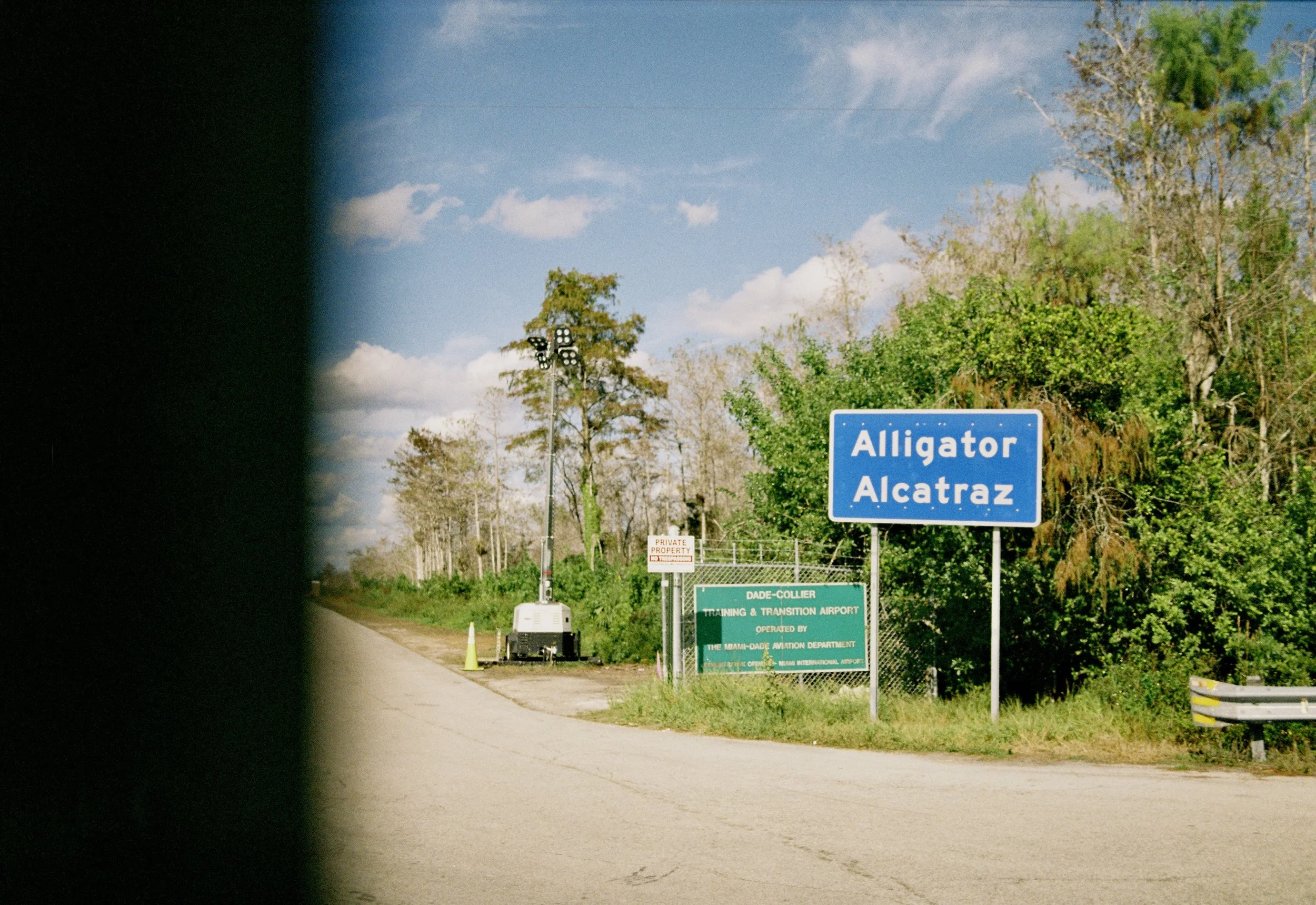
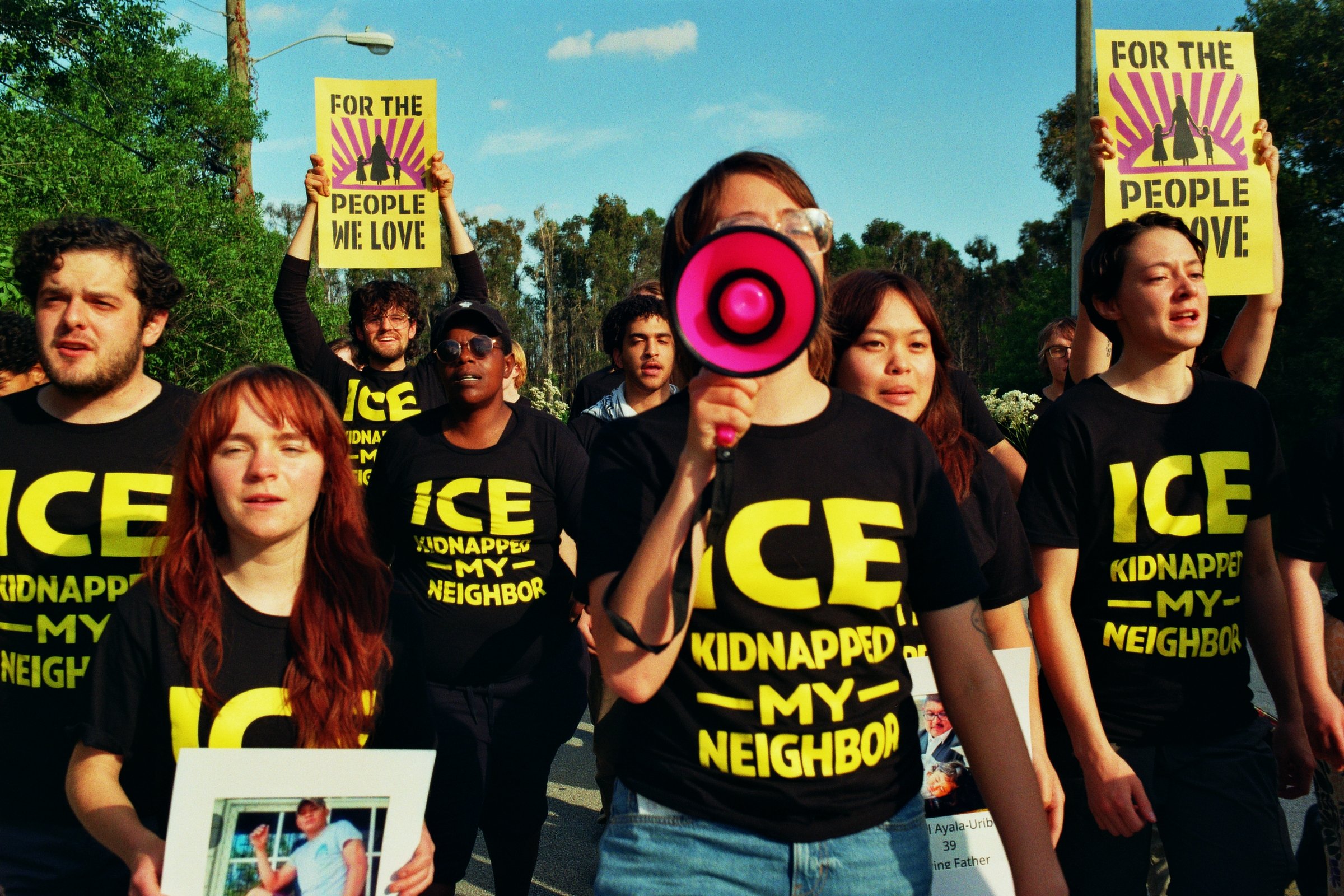
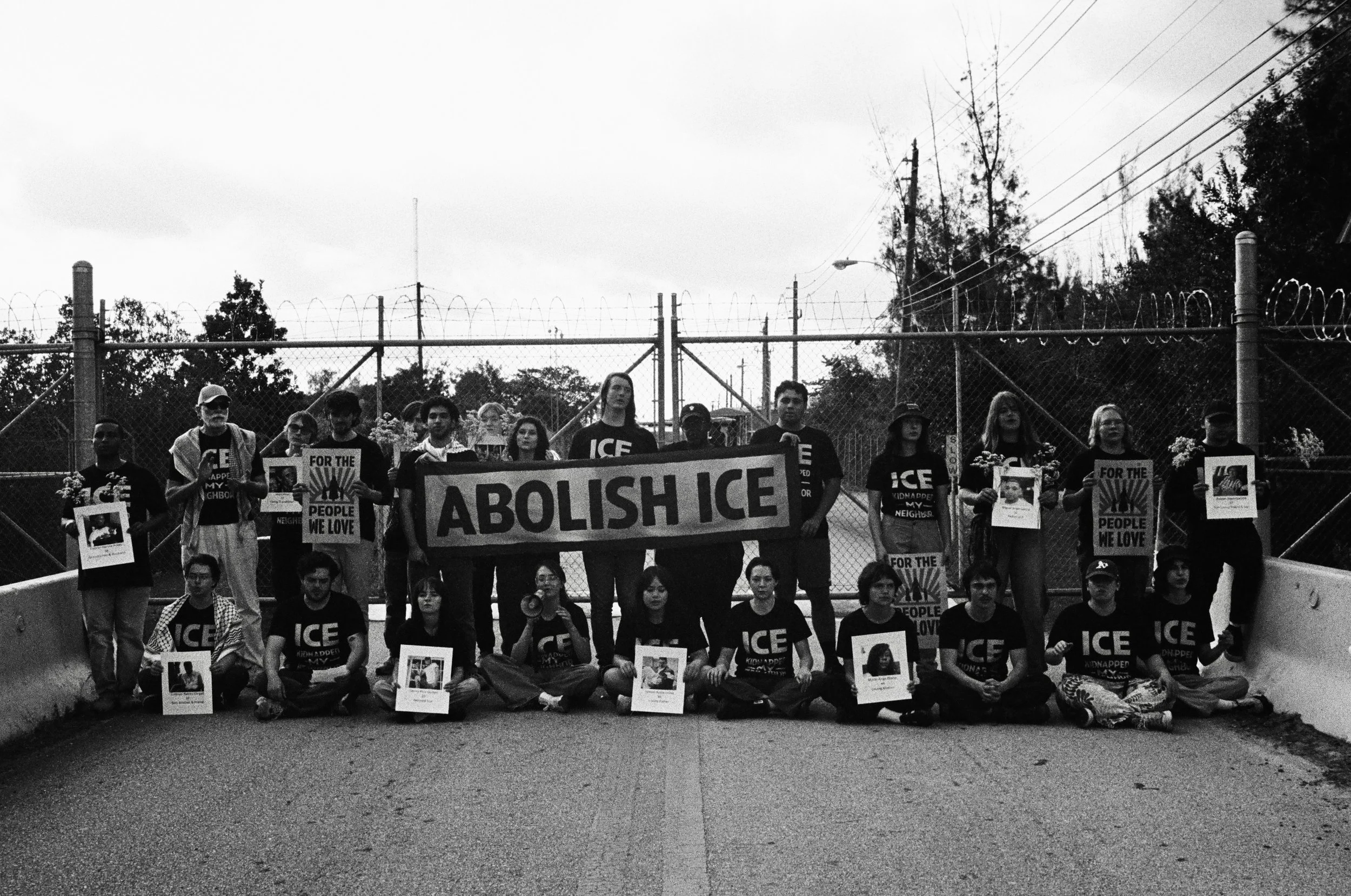
My heart was pounding in my chest as our car turned out of the parking lot of the gas station and onto the road where, several yards away, was Krome Detention Facility, an ICE detention center outside of Miami, Florida, where Sunrisers would be taking direct action.

Though nervous, I was clear-eyed about why I was doing what I was doing.

For months, I watched, horrified, as masked thugs walked the streets, zip-tied families in the middle of the night, snatched mothers or fathers off the street without warrant, pepper-sprayed priests, and arrested journalists, without consequence. 

For months, I’d struggled to figure out how to take the violence and devastation playing out on my iPhone screen and do something about it.

Then, Sunrise called on members across the movement to join an action in Florida at Alligator Alcatraz and Krome Detention Facility. 

I was in.
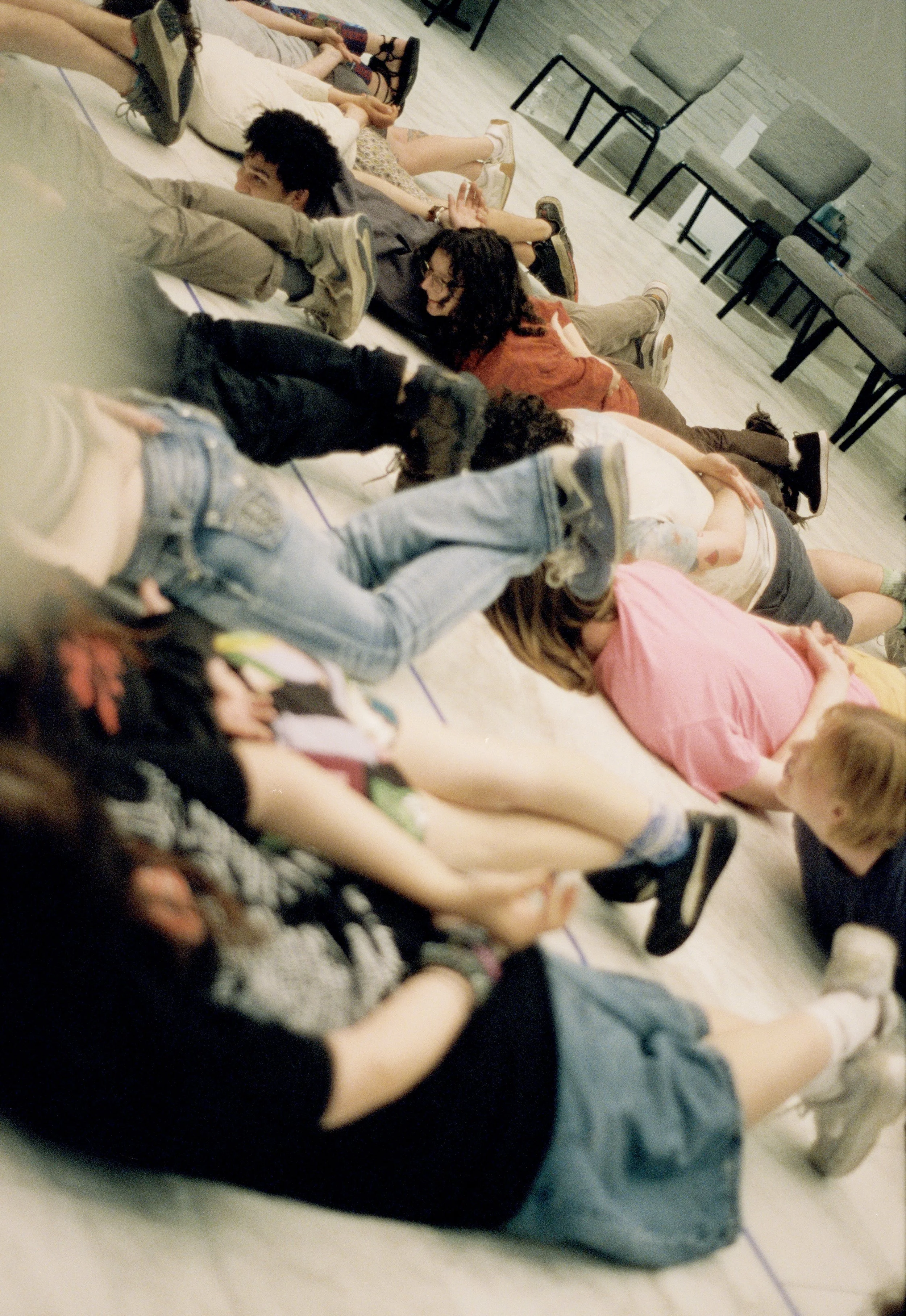
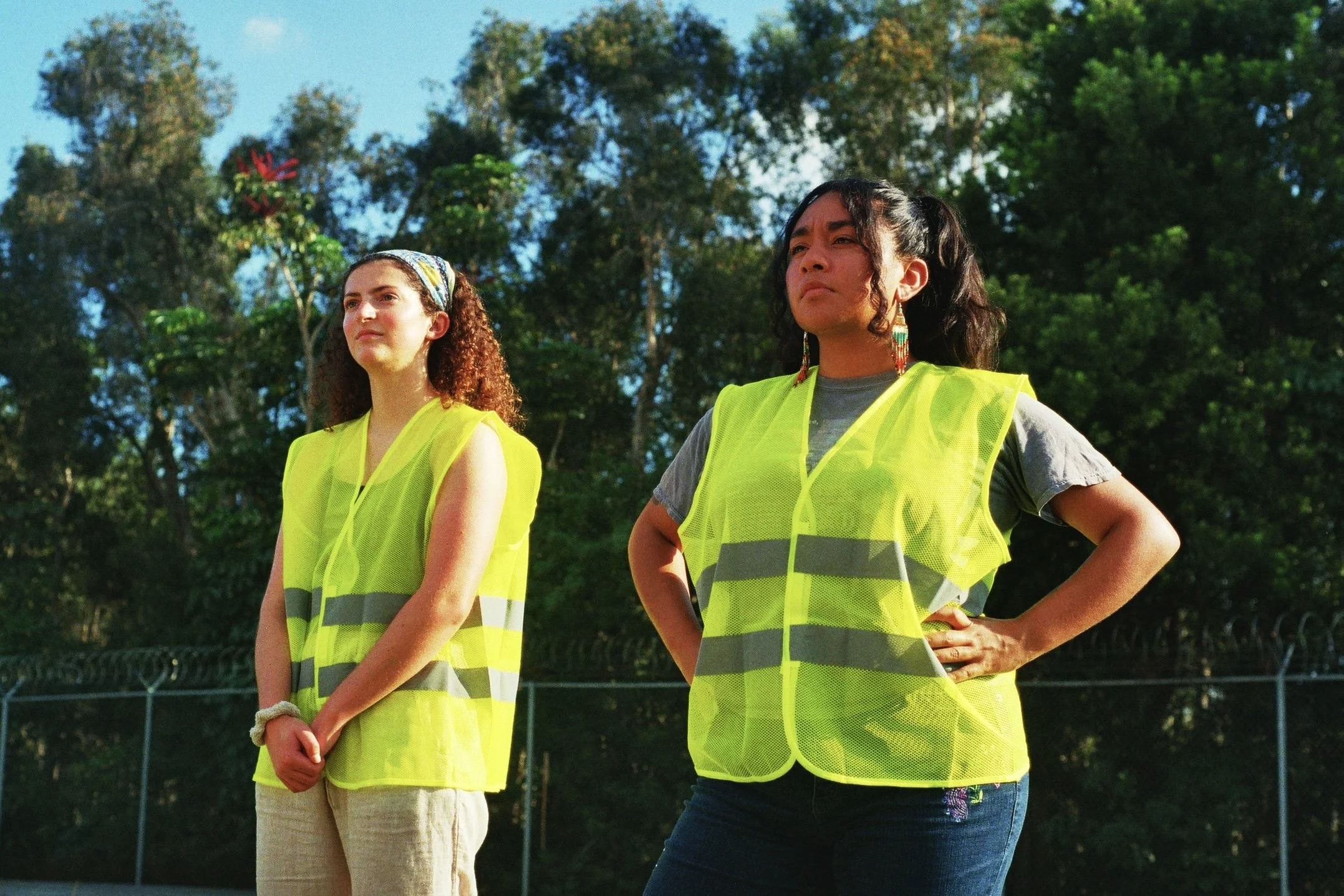
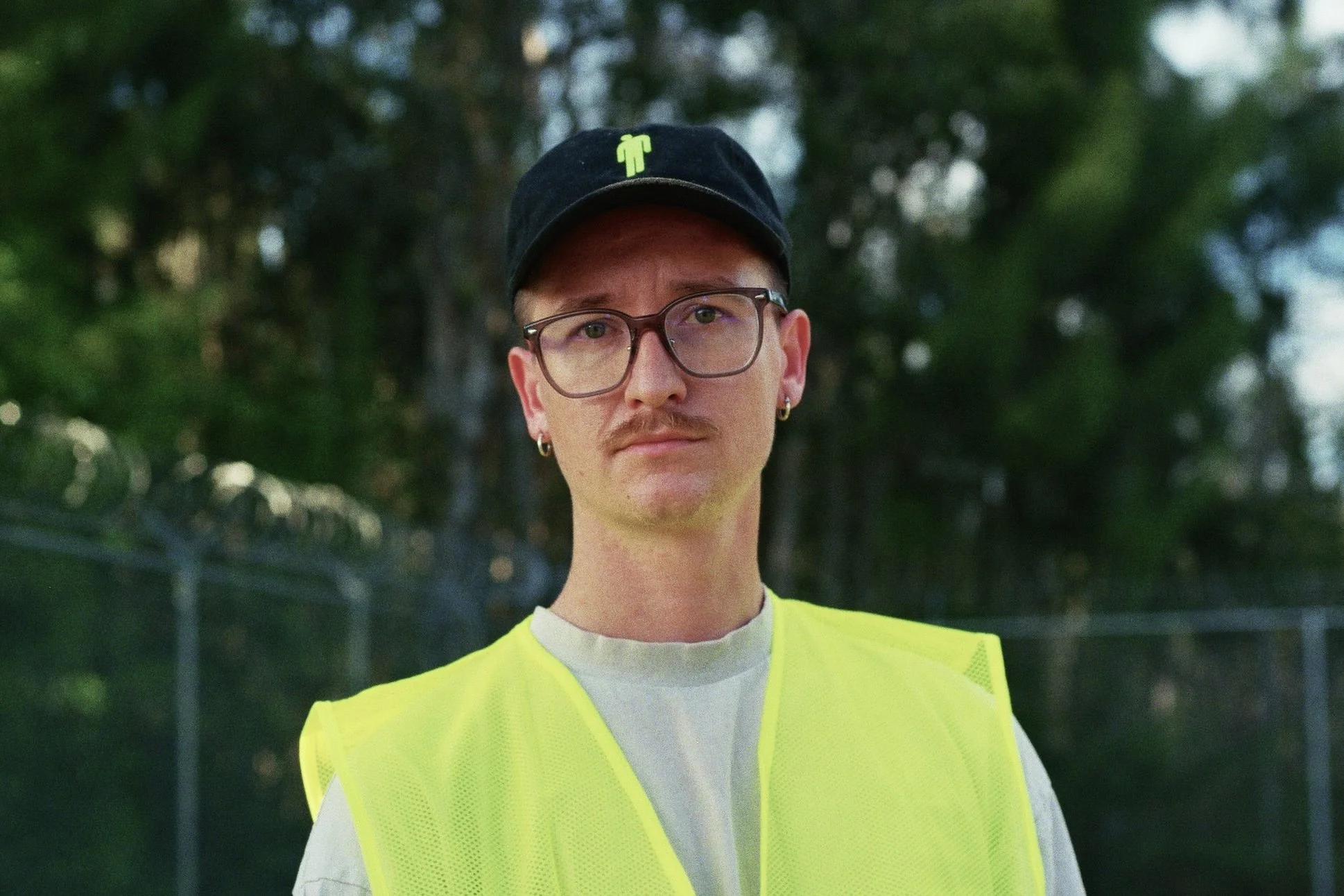
Climate activists prepare for an upcoming direct action.
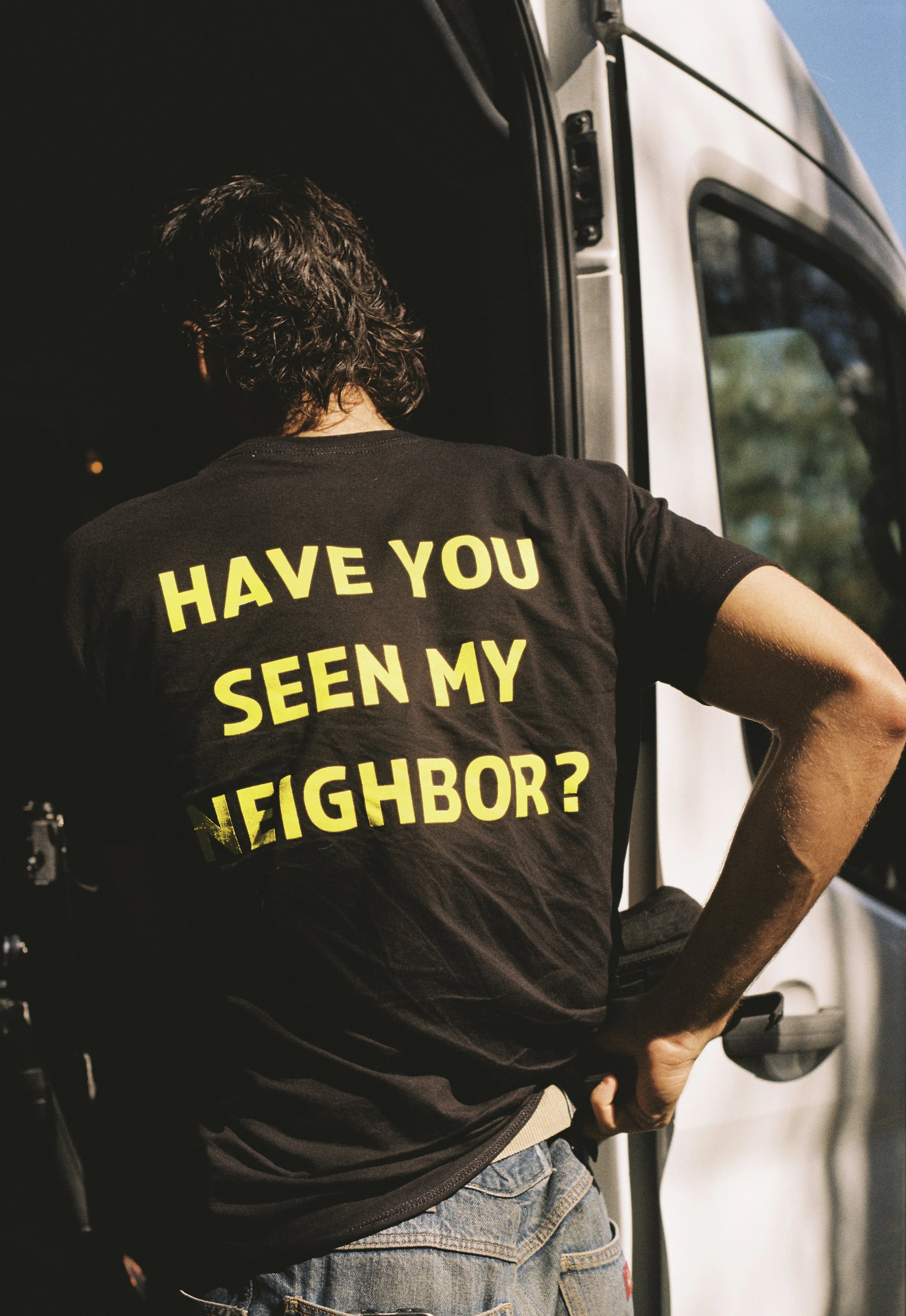
It all begins. 
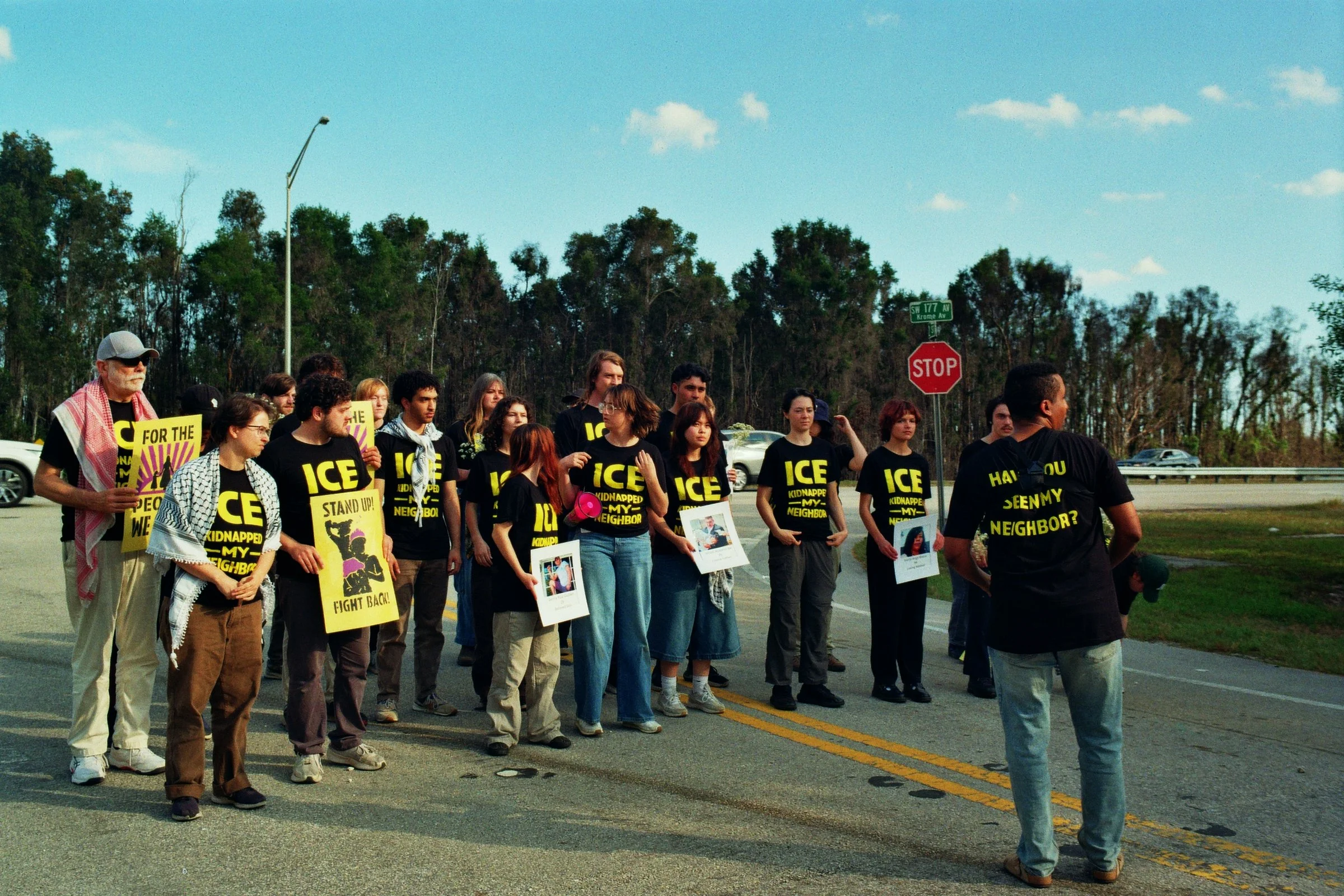
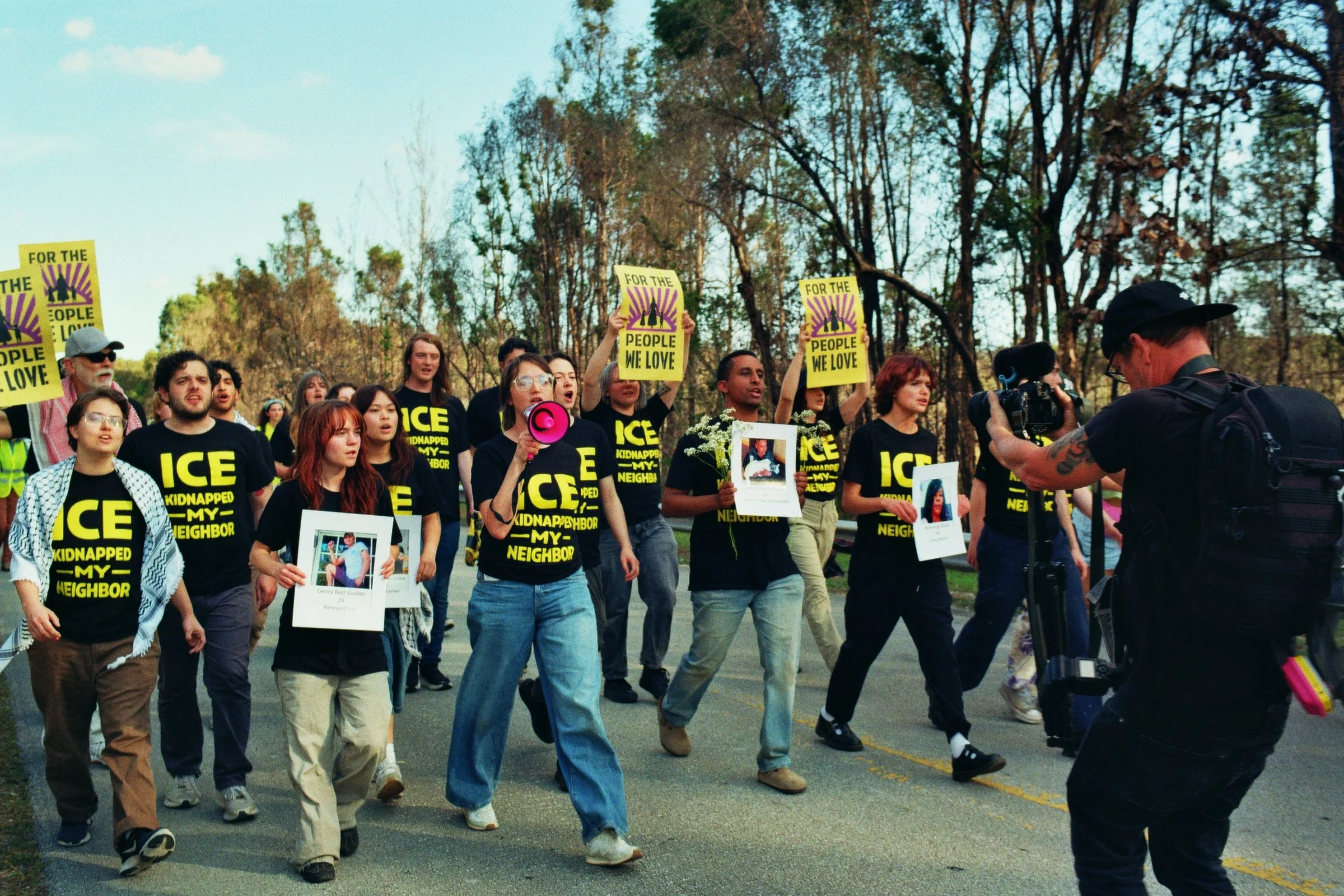
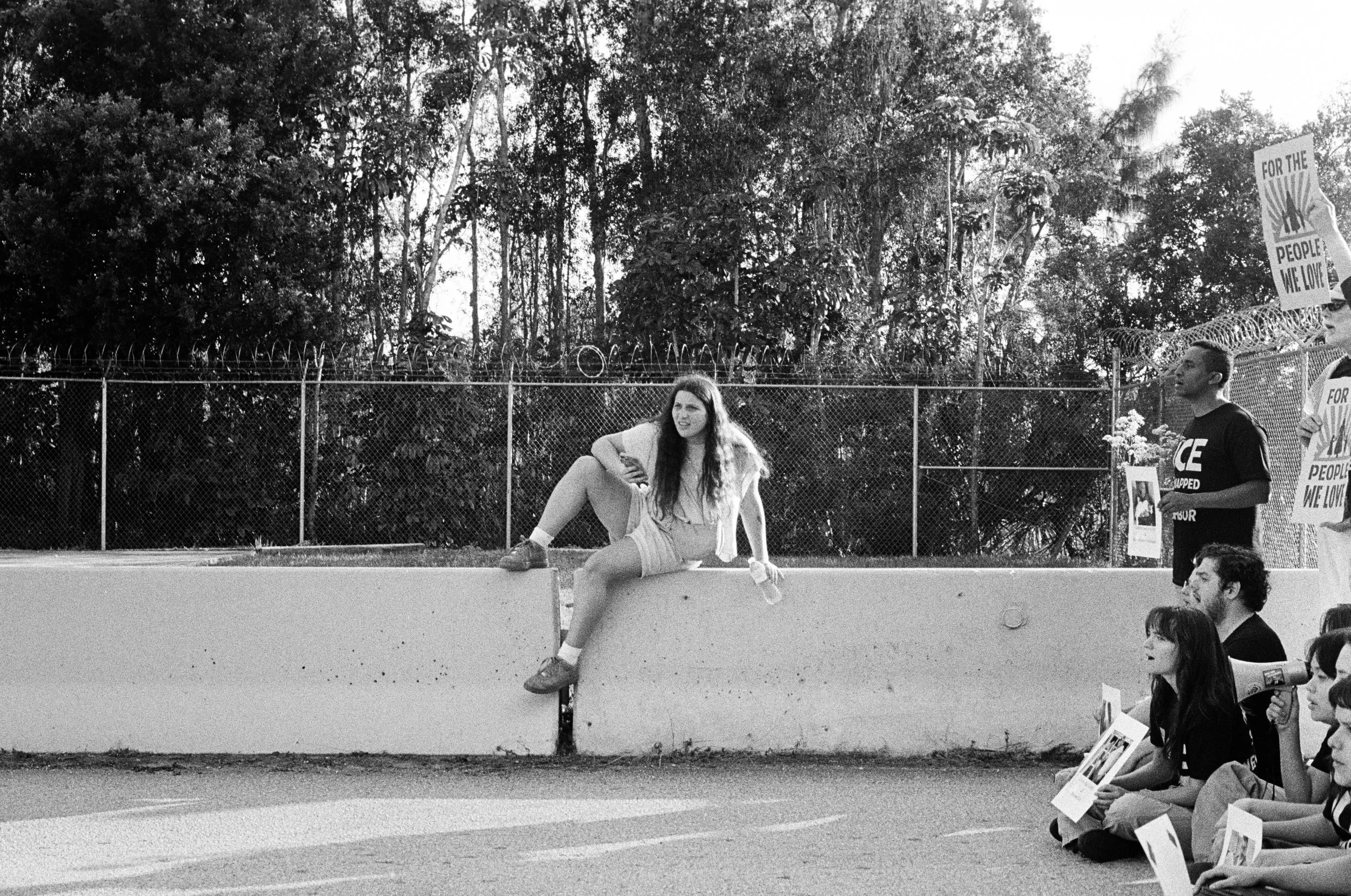
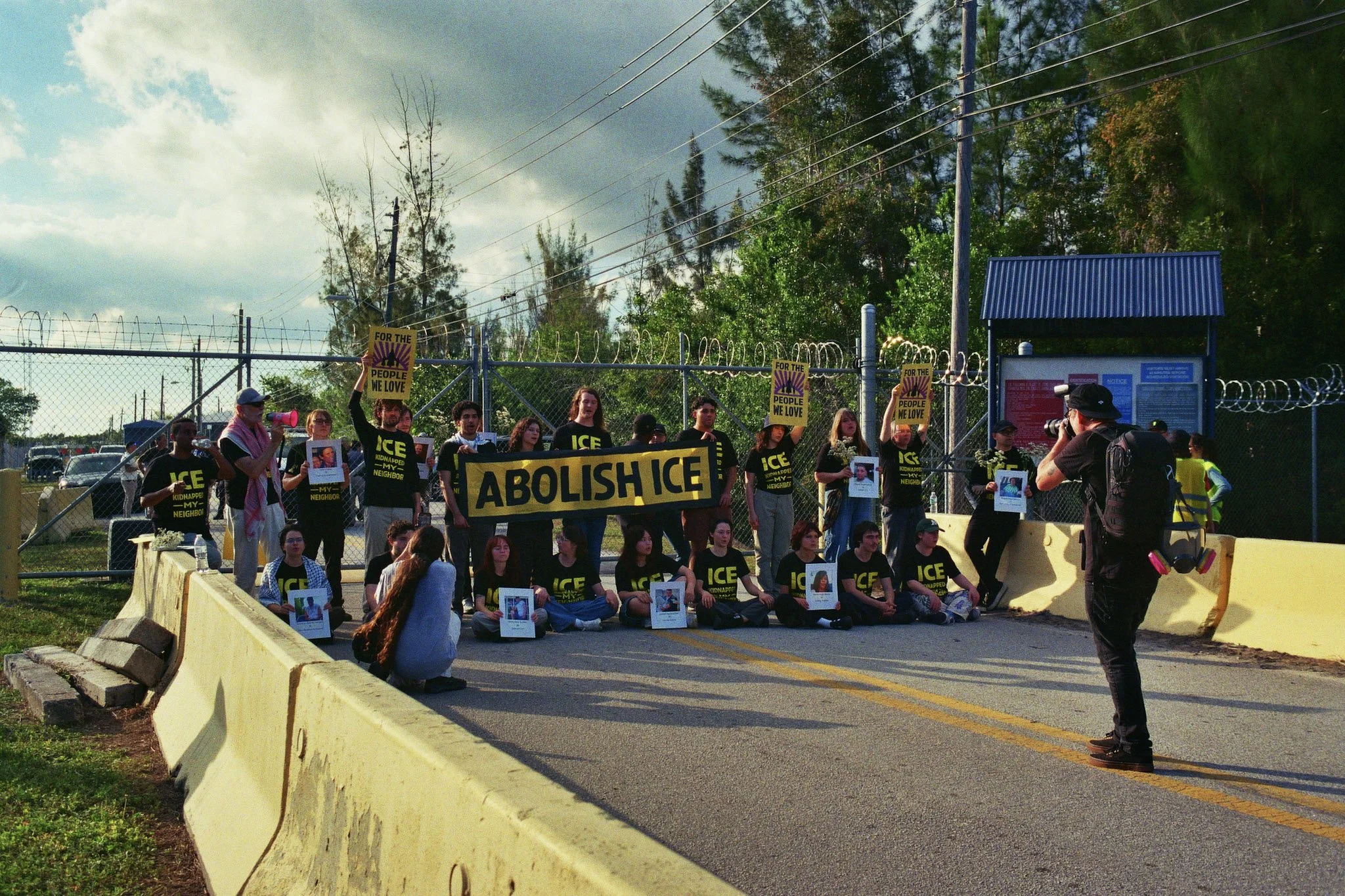
After we marched down the road singing, “I am not afraid, I am not afraid, I will stand for liberation cause I know why I was made,” Sunrisers took their place and stood directly in front of the entrance to Krome Detention Facility. I, the photographer, and a member of the comms team for the action took mine, running around, doing everything I could to get the shot and capture the action. 

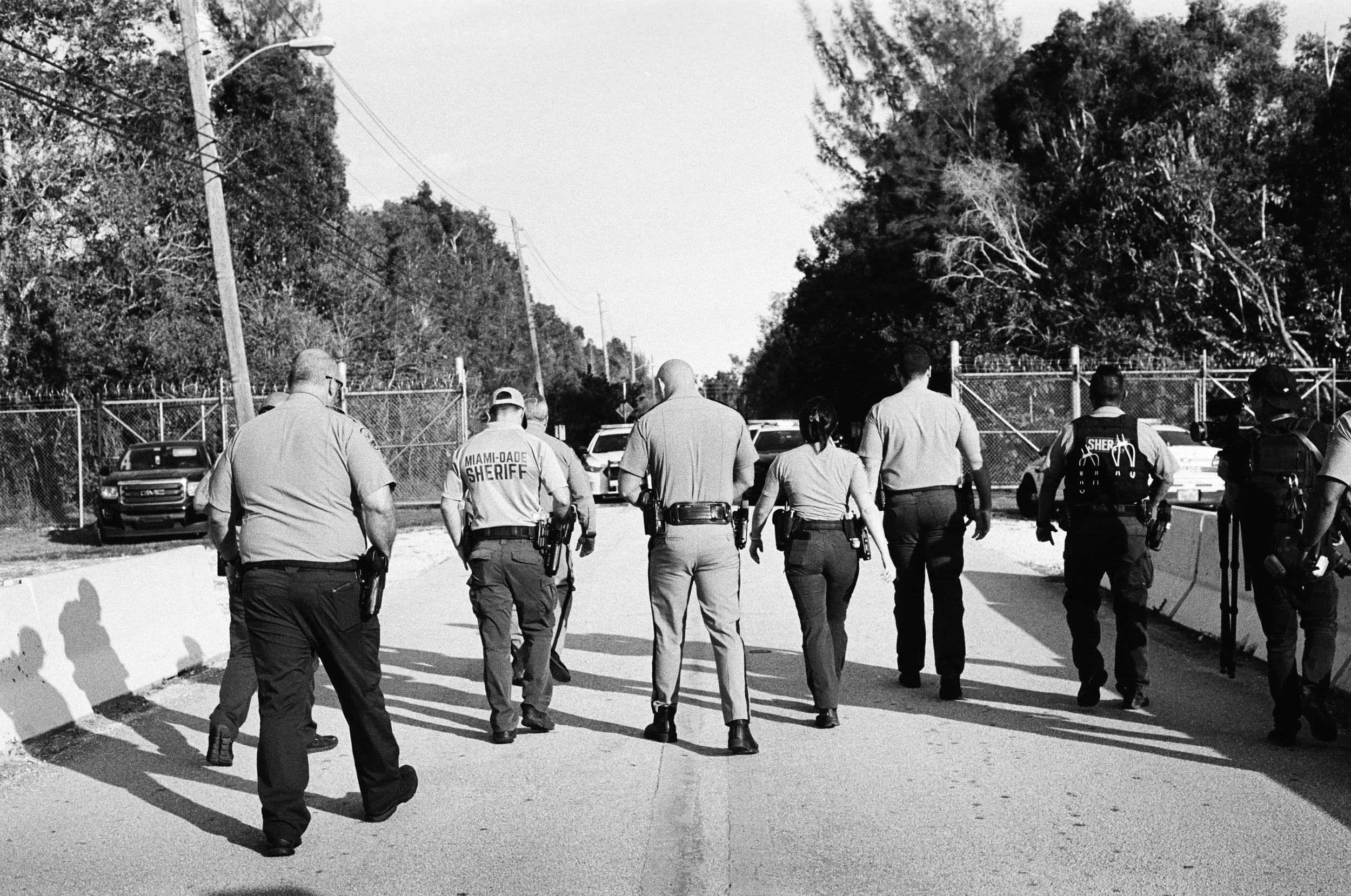
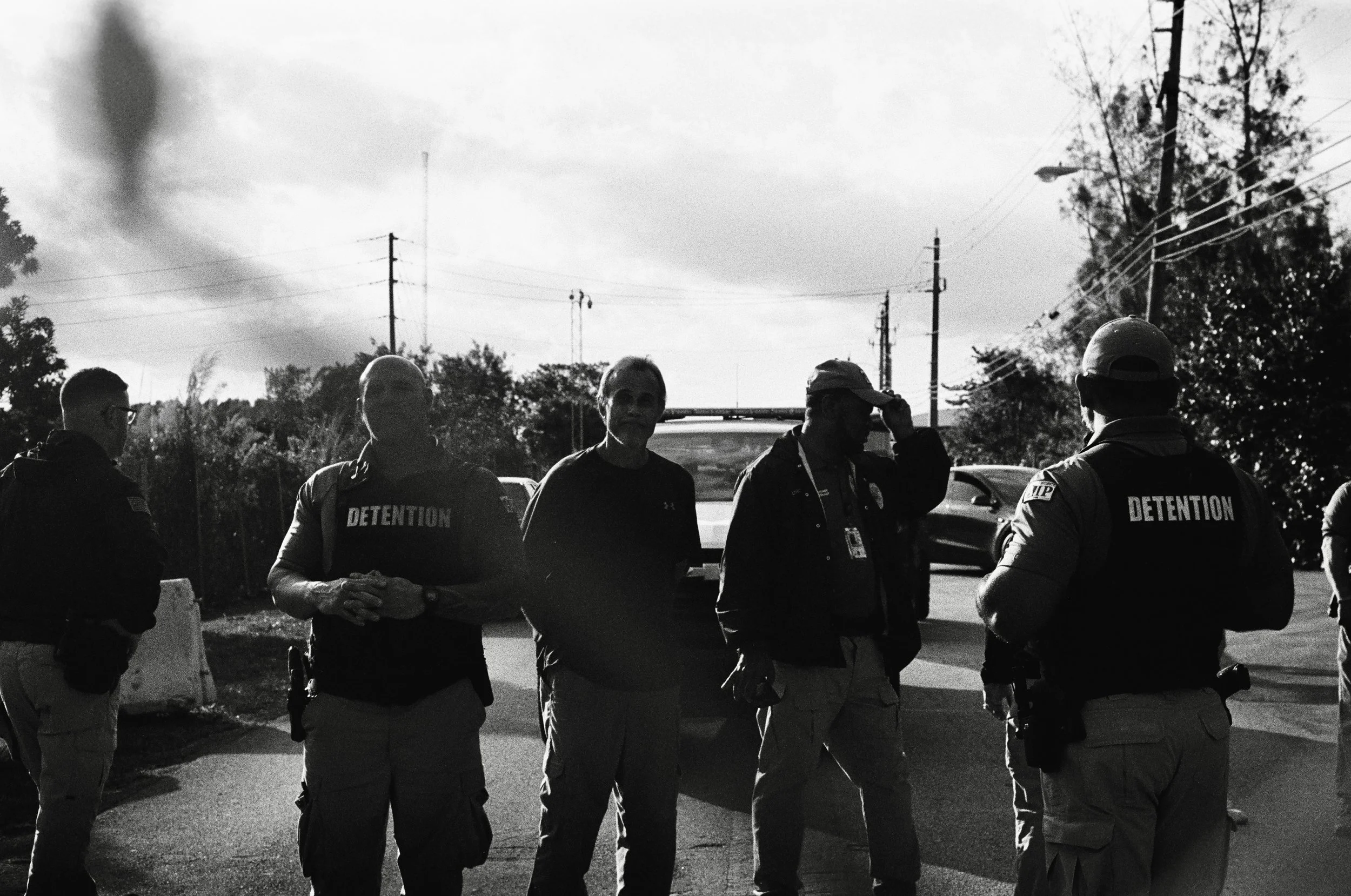
As these things go, when you’re blocking the road for an action, eventually, the police arrive. The head sheriff, a short Hispanic man with a temper, arrived on the scene, police sirens blasting. 

“You have 10 minutes. 5 minutes. 3 minutes. To vacate the property,” he said.

Tension was building. Our jail support liaison was going back and forth between the group and the police. Several more county sheriff cars sped into the driveway to the detention facility. The singing continued. 
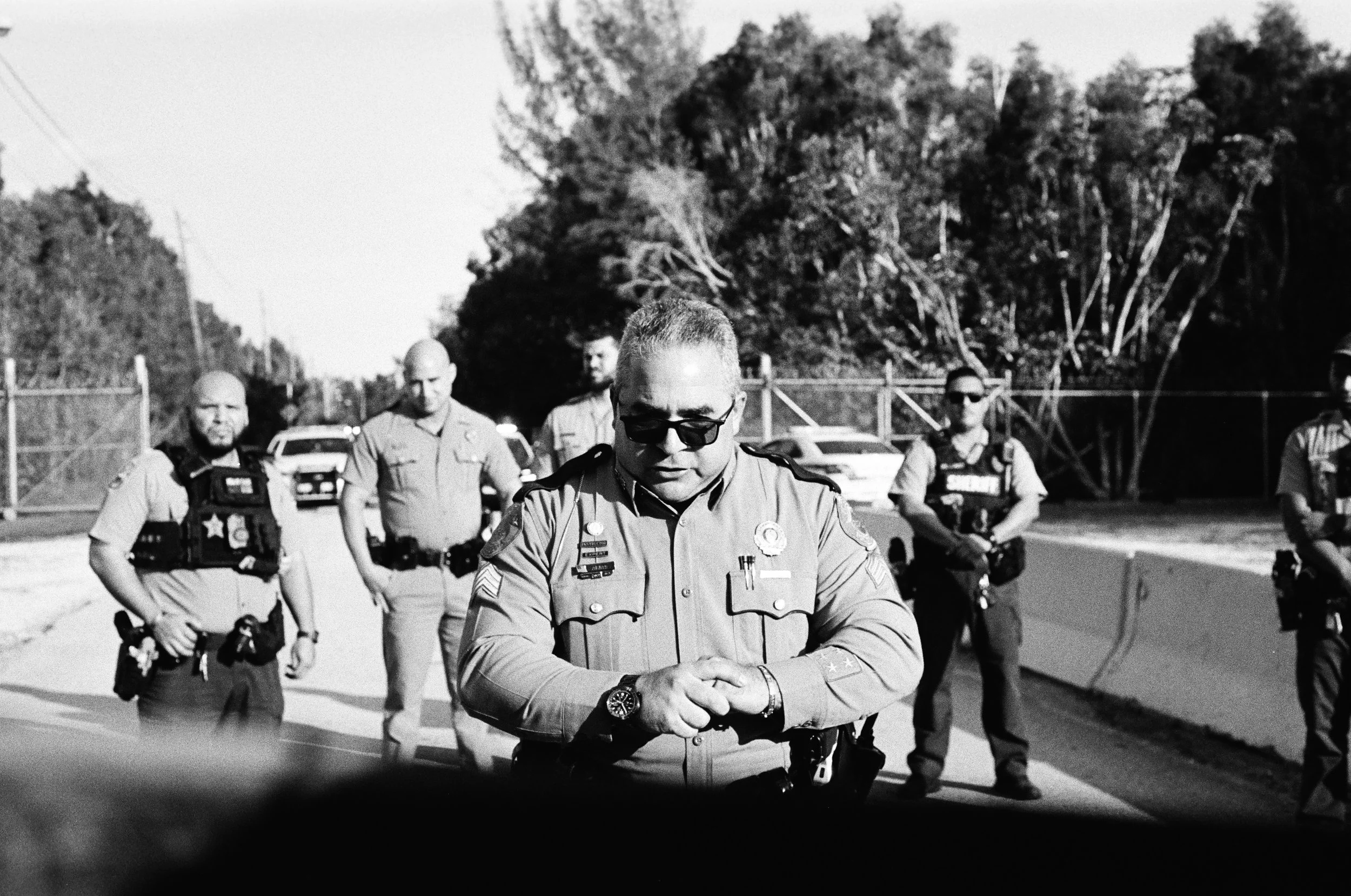
Eventually, the 10 minutes were up, and the arrests began. I threw some rolls of film to a marshal, in hopes that the police wouldn't destroy them. As my friends around me were grabbed by police, camera in hand, I was there to document it, up until my own arrest. 

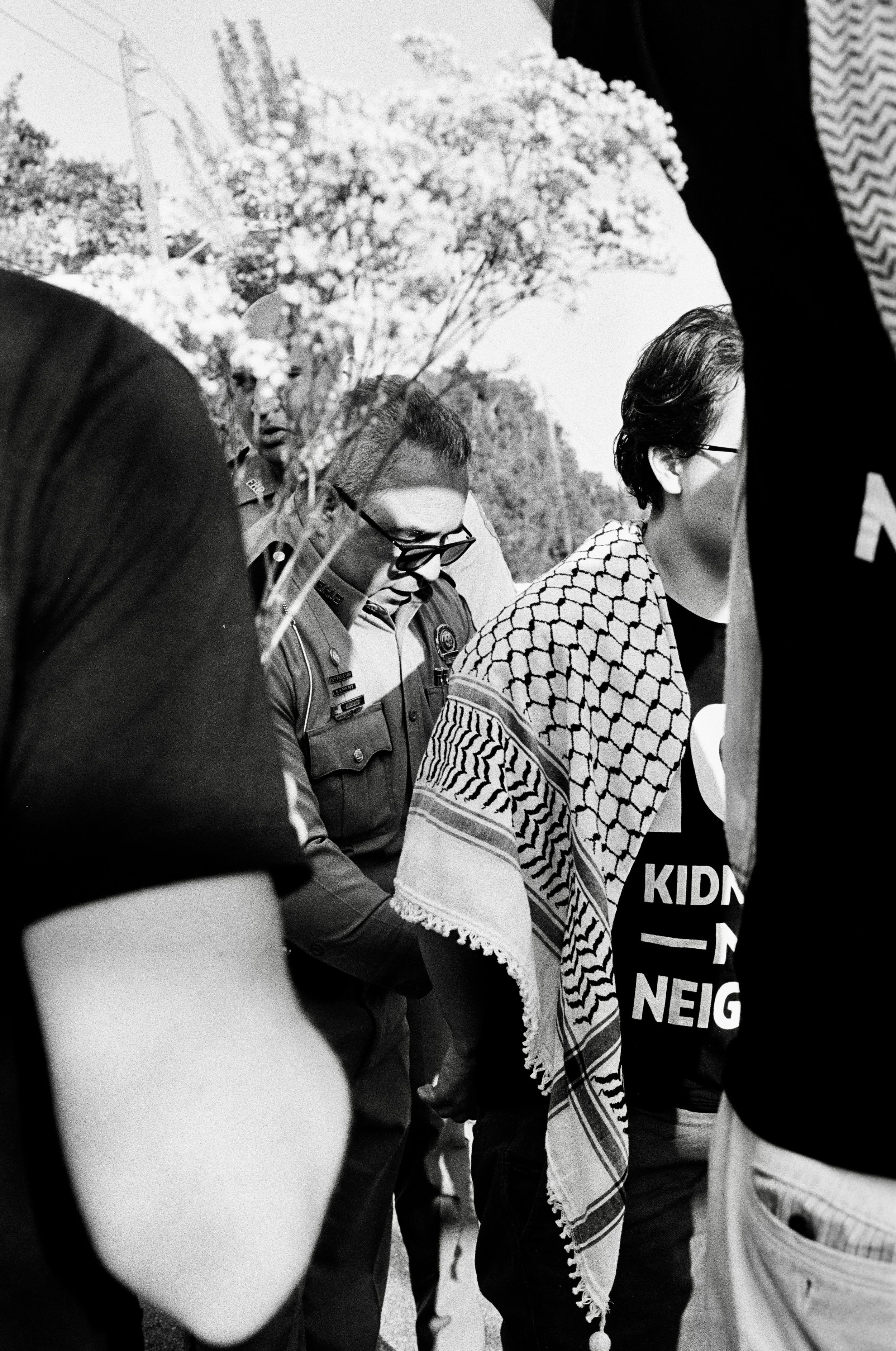
Eventually, I was taken and handcuffed, my camera hanging around my neck. An officer asked for it.

 “Sorry, sir, my hands are kinda tied up right now,” I smirked at my clever response. He did not. 
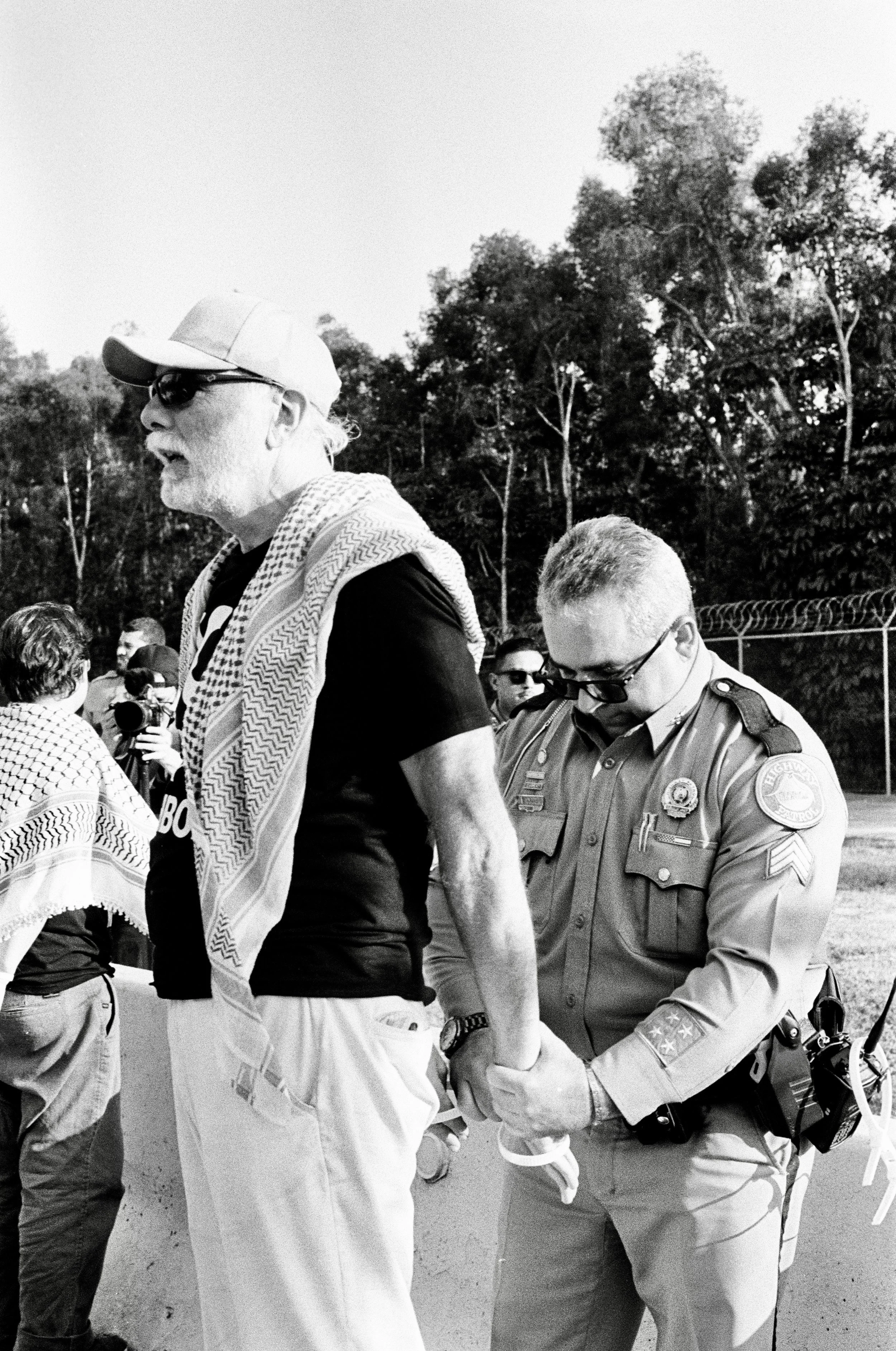
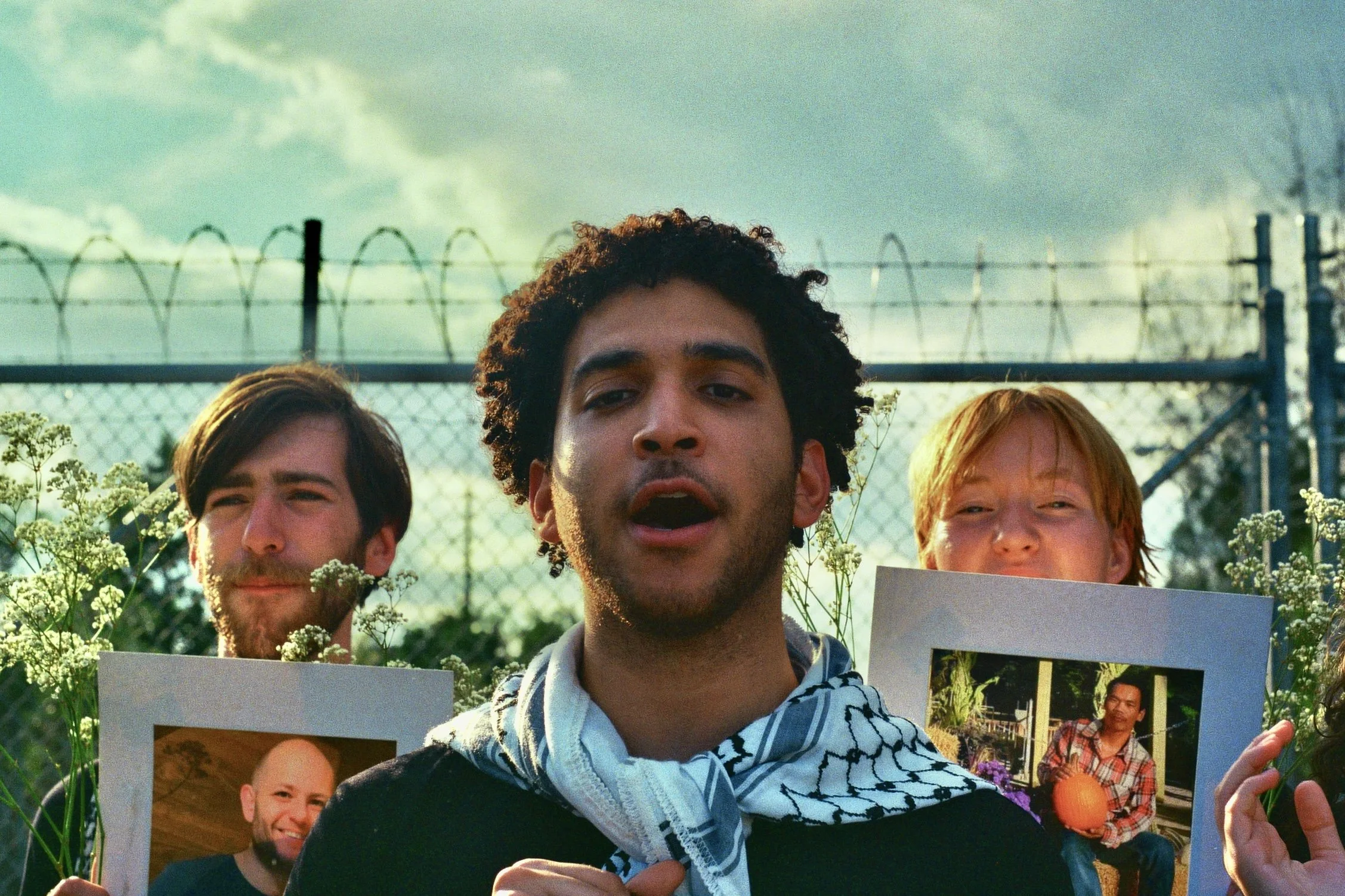
Activist get arrested outside of Krome Detention facility for protesting the conditions inside of the detention facility and ICE’s actions across the country. Nov 2025.

One by one, the officers arrested us and had us sit on the concrete pavement to the side of the road. Processing began. Slowly. As we waited, bored out of our minds, we found ways to pass the time. We sang. We talked to each other and told jokes. Ants attacked a group of people down from me. A cop, trying to be benevolent (is there such a thing as a benevolent cop?!), tried to help. 

As time passed, the sun set on a scene of 30-ish young people seated and handcuffed on a concrete slab outside of Krome Detention facility. Soon after, a pinkish-orange hue lit the sky, and a pelican flew in and perched atop the barbed wire fence surrounding the detention facility. As the bird sat still, we debated whether or not it was stuck. I now think about the symbolism of the bird arriving at the time that it did. Brown Pelicans, I learned,  represent resilience. At the moment, the bird felt like a bit of a sign from the universe, telling us that it, and the forces of good around the world, were looking over us and on our side. After a while of waiting, the bird, without constraint, gracefully flew away. 

As the sun set and the mosquitoes began to bite, eventually several big vans arrived to take the 30 of us, at this point exhausted and bitten, away. I piled into the van, and we headed for the first processing facility, somewhere near Doral. 

At the next facility, we waited. Inside the van, which was partitioned into 3 sections, with three different groups in each, I bonded with the folks in my section. 

Eventually, I got thirsty and asked for water from a Black officer who looked to be just a few years older than me. Eventually, once I exited the van for processing, he was there with my water. With my hands tied behind my back, I opened my mouth as he poured the water in my mouth. I knew the moment was just as awkward for him as it was for me. In another context, I might pass him at a bar. He might be the cousin or relative of a friend. Here, he was the police officer playing a role, and I was the activist.

After what felt like forever, we eventually headed towards Miami-Dade County jail. 

Headed to jail.

I sat, handcuffed, in the backseat of a squad car with two other Sunrisers. The officer driving us, a Black man, began blasting Afrobeats and Let Me Love You by Justin Bieber. I couldn’t help but bop along to the tunes as the squad car raced through the streets of Miami, headed to what I would soon learn was Miami-Dade County Jail (where apparently Justin Bieber had once visited). I thought… this has got to be a joke. 

We arrived at the jail and sat in the squad car for what felt like an hour, waiting to be processed. I peered over the officer's shoulder, watching as he watched random YouTube shorts on his phone. 

Eventually, still in handcuffs, we were taken inside the jail, where we ran into some of our other friends who had also been arrested. There, we were asked to take urine samples, see medical, and yet again, wait. 

Also, during this time, I remember a little spat happening between an arresting officer and a staff member of the jail. As they yelled back and forth, I grinned inside … good, have at it. 

Inside the waiting room,  there was a pregnant woman, whom I presume to be Haitian, who didn’t speak any English. She looked terrified to be inside. Later, I would see her on a stretcher, completely mute. There was another woman, an older Latina lady, who just sat beside me bawling. I tried to ask her in Spanish, Are you ok?, but she was consumed by her tears. 

I began to learn that there are checkpoints, as I’ll call them. Our photos were taken (hence, the mugshot), and I was forced to take out my cartilage piercing and nose piercing, which hurt like hell. We then had to give up our clothes and change into an orange jumpsuit and a white bra and panty set. We then went into another waiting area, where they gave us a disgusting sandwich that I could not touch. And we waited. 

Jail is a never-ending series of waiting.

Here, they had a phone, so I called Tori, our jail support lead, to let her know that I and many of us were ok. I then called my mother, who did not answer. Which made sense; by this time, it was somewhere around 2 am. 

After a long day,  I was exhausted. I just wanted to lie down. I also wanted a blanket… It was freezing. 

As we were taken deeper and deeper into the system, our presence began to cause a bit of commotion. The state, in Florida, was obviously not set up to process 30 people at once. As we interacted with the staff and many other Black and Brown people, they couldn’t understand why we’d want to go to jail. I don’t want to go to jail, I thought. But if it’s the price I have to pay to stand up to injustice, so be it. 

At valuables (or the place where you check your clothes and things), one woman claimed, as we talked about the horrors perpetuated by ICE across the country, that we were brainwashed and needed to seek the truth… right back at you, sister! 

Another correction officer shared a story about the time an older Russian or Turkish woman (I can’t remember exactly) inside was deported… her husband had come to the jail one day and learned the news. He said he would not forget the man’s cry as he found out. He thanked us for our efforts. 

After a bit of waiting, eventually a few of us were called and taken to the next step, to our jail cell. I was relieved (your standards of comfort in jail adjust pretty rapidly); I just wanted to lie down. 

We walked the corridors in handcuffs, tied to each other by our hands and feet, and after being taken through elevators and different floors, I eventually arrived at my jail cell. 

It was colder than Antarctica there. I took the thin sheet they gave me, climbed to the top bunk, made a makeshift pillow out of the towel they gave me, and tried to fall asleep. Sleep would be my strategy for navigating this misery. 

I woke up several hours later, completely disoriented, forgetting for a second where I was: in jail. 

My tired eyes began scanning the scene of the cell. There was a silver toilet and sink in the cell, and stuff from my cellmate scattered around the room. Toilet paper. Books. Food wrappers. Again, it was utterly freezing, and as I looked to the source of the cold, a vent was pasted with toilet paper.  I’d later learn why. 

I crawled down from my bunk and tried to pull the door open. 

It’s locked, my cellmate said. Locked?! 

How do I get out? I asked her. 

You have to wait; they give you certain periods where you can leave, and once you leave, you can’t come back in. 

My cellmate’s name was Mary (I’m using another name, obviously, out of respect for her identity) I began asking her a series of questions, trying to understand the woman I was now locked in a jail cell with. She had been in jail for 6 months and had 3 more months to go. She’d broken a restraining order and was set to be deported at the end of her stay. 

In my own misery, I asked her, “How do you do this!?” “You adjust,” she said. No. I couldn’t. 

As we waited, she eventually asked me if I’d help her with something. “Would you get on my shoulders and help me pad the vents?” 

My mouth dropped. Pad the vents? Mind you, the jail cell ceilings were high, and the vent had to be about 10 feet up. That would explain the toilet paper over the vent. “Sorry, I really can’t do that.” I did not want to break my neck. I also did not want the guards to see me and give me any more time than I already had in this hell. 

Eventually, after returning to bed and waiting, the guards came around, knocking on the doors. “What’s this?!” I asked. She told me I had to stand outside of the jail door until they came around to inspect. 

During my entire experience in jail, I thought they could really use a manual and orientation video for newbies. I had no clue what was going on, and several times, I accidentally broke the rules as a result. But what were they gonna do, put me in jail?! 

Once they had done the inspection of our room, we were free to leave. The small jail cell, that is. We couldn’t go far, obviously. We were in jail. With my newfound freedom, I found the closest phone on the wall, lined up, waited, and then called my mother. I talked to my mom for a bit, in good spirits (though cold), told her I was ok, and then got my sister's number from her and called my sister. “GIRLLLLLLLL… I said.” I told her everything about my experience so far. The experience, up to this point, that I have written out for you. 

After the phone calls connecting with my family, I saw they had an outdoor courtyard, and I ran to it. Oh, to be outside! Fresh air! The sunlight on my skin was refreshing. While outside, I spotted two other Sunrisers from the action and ran to them. How refreshing!!! I needed someone to process this insane experience with. When talking with them, I learned that apparently, the action was on the news, and a few people inside caught wind that a few of us were the kids who took action on the news. 

Jail is truly what you see in the movies and shows. People in orange jumpsuits. People working out. This one girl was running in endless circles around the courtyard for exercise. It felt like a scene straight out of Orange Is the New Black. Art imitates life. Imitates art. 

One girl came up to me. “I love your hair.” I was wearing cornrows. This was not for jail, but rather, between silk presses and knotless braids, I needed a temporary hairstyle. 

“You’re pretty! What are you doing here?! Girl, be careful!” Yet, despite it being jail, I wasn't at all afraid of the people inside. 

A waiting game.

Jail, given the many things we’re accustomed to entertaining ourselves, was especially boring. I knew that if I could find a book or something to read, it would make the experience more bearable. I used the people skills I’d developed in my 29 years of life and thought they’d also apply in jail. A white girl was sitting at a nearby table with a pile of games and books. I walked over. I was desperate. I asked her where she got the cards from. 

“My family,” she said. How nice of your family. I thought she would offer them up, but she didn’t. So I looked at the books; one of them was Rich Dad Poor Dad, from what I can remember. “Can I read that?” She looked me dead in the eye and said no. 

I felt like I went through a never-ending loop over the span of 10 hours, between sleeping, going to the courtyard, and making a phone call. Rise and repeat. Though frustrated and restless to get back into the world, I was fairly calm. As I watched this all play out, eventually, I asked my cellmate again. “Why don’t you all protest this? This is miserable!” “Protest?! Hell no. They’d just give us more time.” I also guess protest is what got me here in the first place.

In an effort to pass the time, I walked up to the guard seated, watching television. Throughout much of this experience, I couldn’t help but think about how many people had no idea of this parallel universe playing out in jails across the country. 

“So when I get out of here, do you think there’s any chance I could come back and, you know, bring my camera and photograph this?” She looked me dead in the eyes. I took that as a no. 

After the cycle of waiting, of napping to pass the time, of trying to create worlds in my head that I could escape to, of trying to meditate and breathe, eventually, they called for me. Dejah Powell. After one or two more hours of processing and steps, eventually, I saw the light of day. The second I saw Tori, I cried. I did not ever want to go back to jail again. 

Endings are messy. 

And so will the ending of this piece be… because I’m not quite sure how to close. 
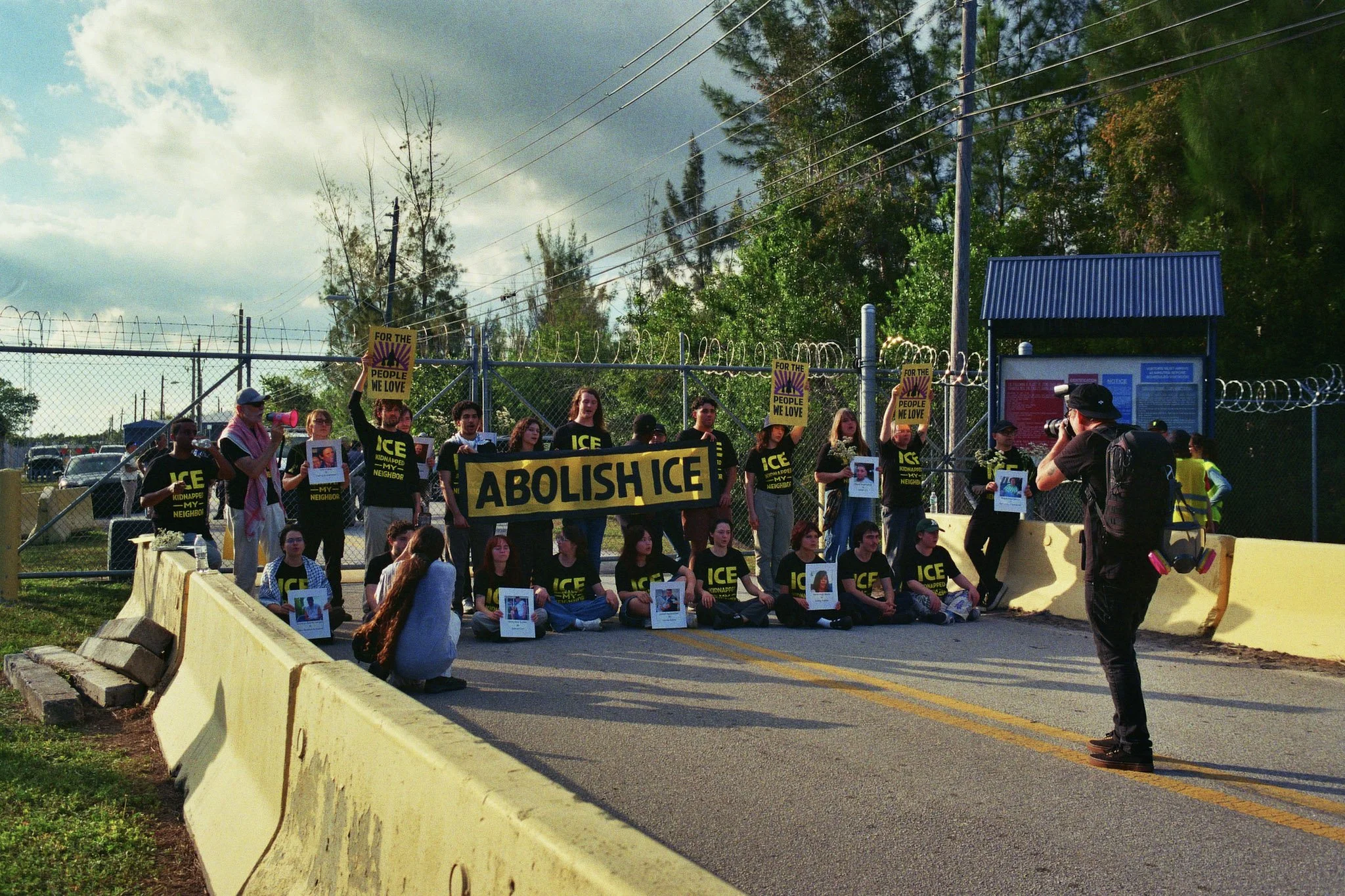
A group of climate activists, calling to abolish ICE, blockaded Krome Detention Facility in Florida in November of 2025.

Should I close by telling you I’ll never get arrested again? (I can’t promise you that I won’t, given where things are headed in this country.) 

Close with thoughts on the state of the carceral system in the United States? (That’s a whole other essay) 

Close with my reflections on the impact of that action and whether it was worth it? 

Instead, I’ll close with this.

“One has not only a legal, but a moral responsibility to obey just laws. Conversely, one has a moral responsibility to disobey unjust laws.” ― Martin Luther King Jr., Letter from the Birmingham Jail
The second place I went after I got out of jail. The first? To eat.
What would it take to make politics core to the cultural fabric of the United States? 

And the role artists have to play…

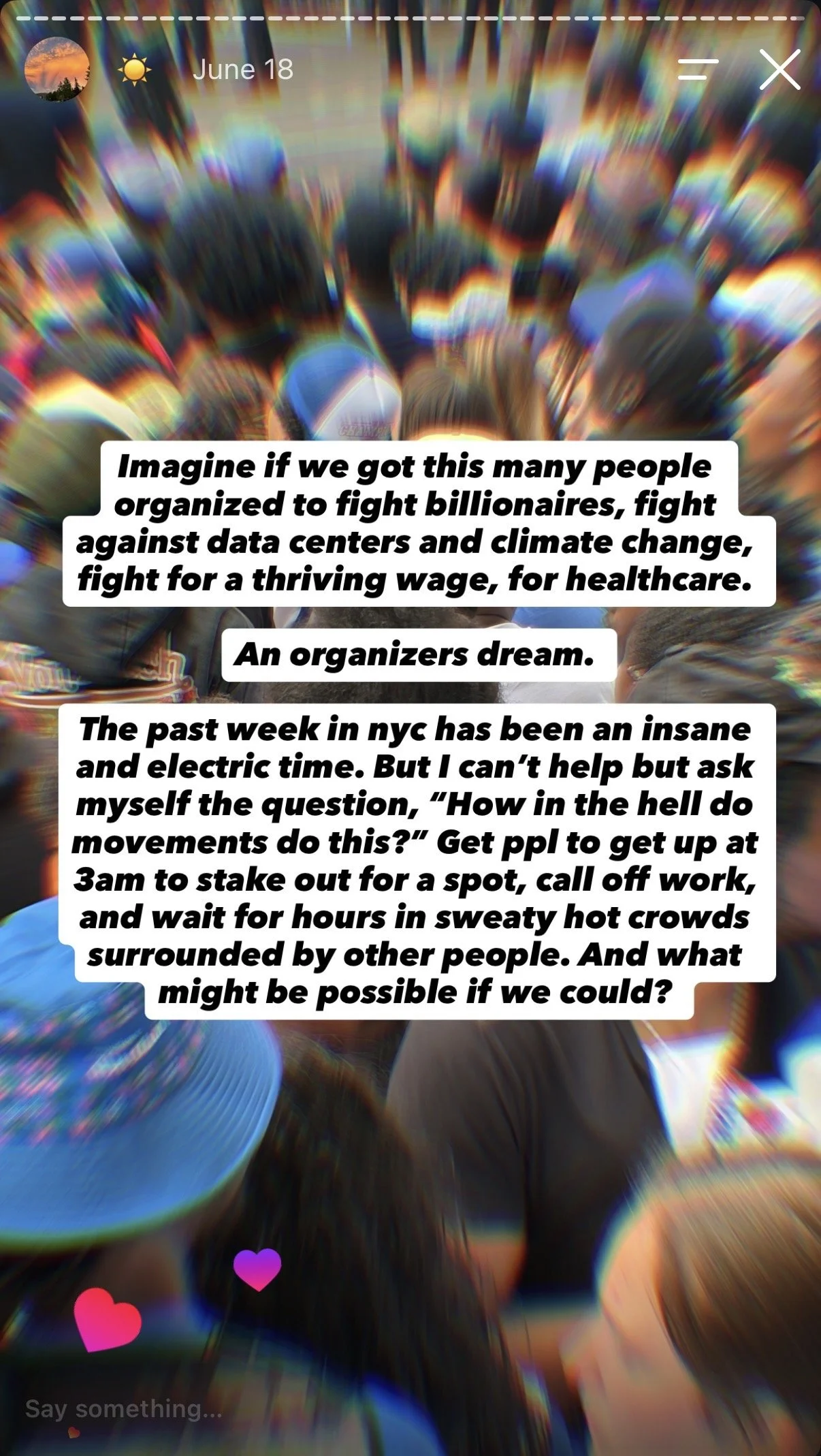
“Imagine if we got this many people organized to fight billionaires, fight against data centers and climate change, and fight for a thriving wage for healthcare… an organizer's dream. The past week in NYC has been an insane and electric time. But I can’t help but ask the question, “How in the hell do movements do this?” Get people to get up at 3 am to stake out for a spot, call off work, and wait for hours in sweaty, hot crowds surrounded by other people. And what might be possible if we could?” - Me, June 18th, Instagram

​I’ve been in a state of despair around organizing and movement building. For the past 7 years, I’ve, through Sunrise, a youth climate movement fighting for a livable future for all, tried to figure out how to build the power and numbers to push the government to act on climate change with the scale and urgency it demands. (In addition to climate, at its core, we’re fighting for a world where people and the planet matter over profits and corporations.)

​In my 7 years or so in Sunrise, now, it’s getting harder and harder to believe that anything - the phonebanking, the door-knocking, the direct actions, the arrests- is worth it, or shifting the balances of power in society. I’m a bit… jaded. I’ve seen us struggle to bring in new members. I’ve seen us struggle to organize beyond the bubble of young people who already believe what we do. I’ve seen us struggle to… build power. We have not set out to stop climate change; in fact, the effects of climate change, in the form of increased wildfires, increased storms, increased flooding, are coming at us full force across the globe.  

​And yes, it’s not all hopeless. There has been an exciting wave of candidates, from Zohran in office to Will Lawrence, Darializa Avila Chevalier, Abdul El-Sayed, and Melat Kiros, very progressive candidates, winning primaries. But what I really think is necessary is sustained, long-term commitment and sacrifice of millions of people across the country to birth a new nation, one that is not run by the billionaires and the corporate elite. And movements haven’t figured out how to do that. So I’ve been trying to look to other places for inspiration.

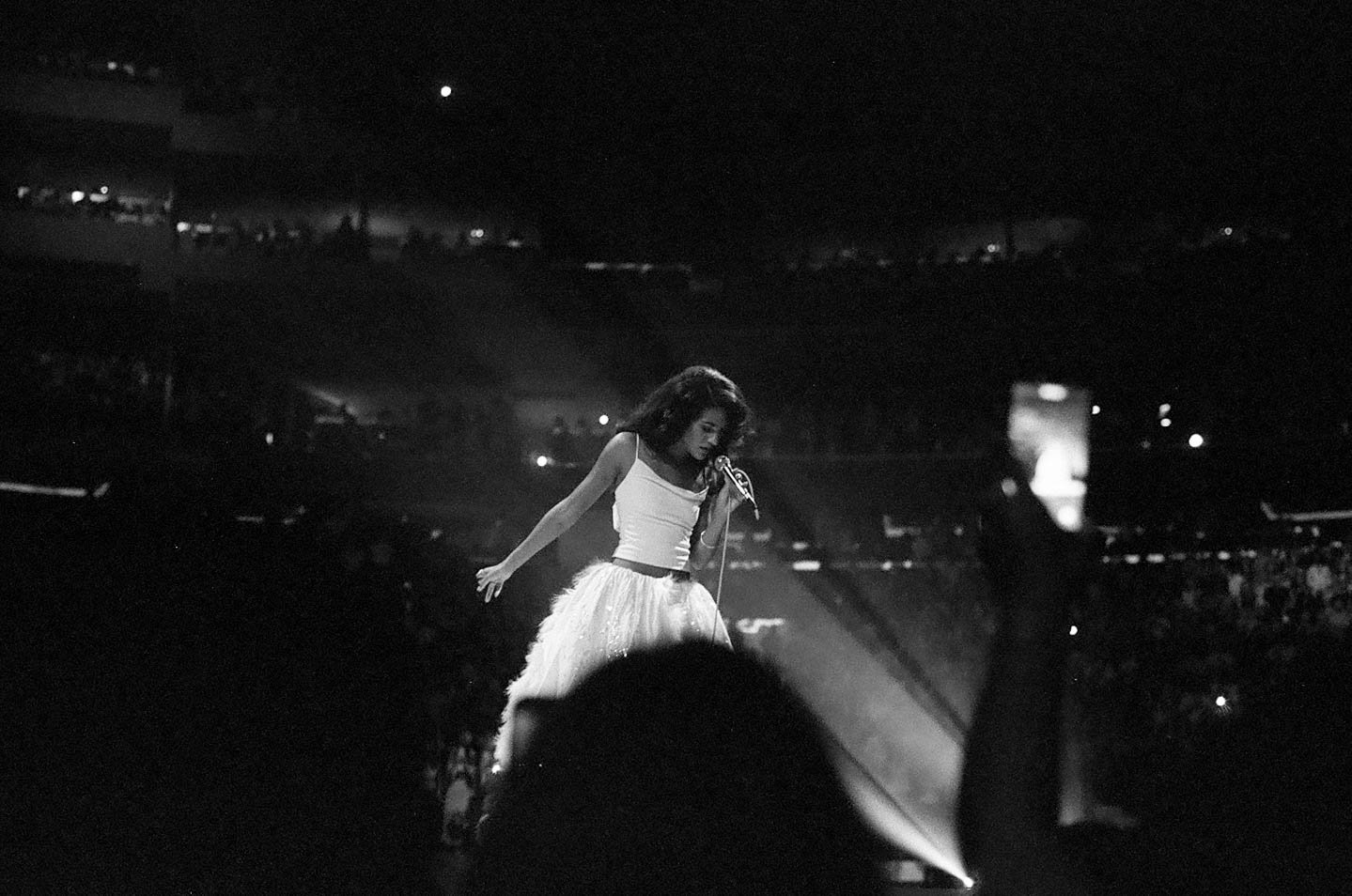
Olivia Dean playing a sold-out show at Madison Square Garden. August 17th, 2026. Dejah Powell.

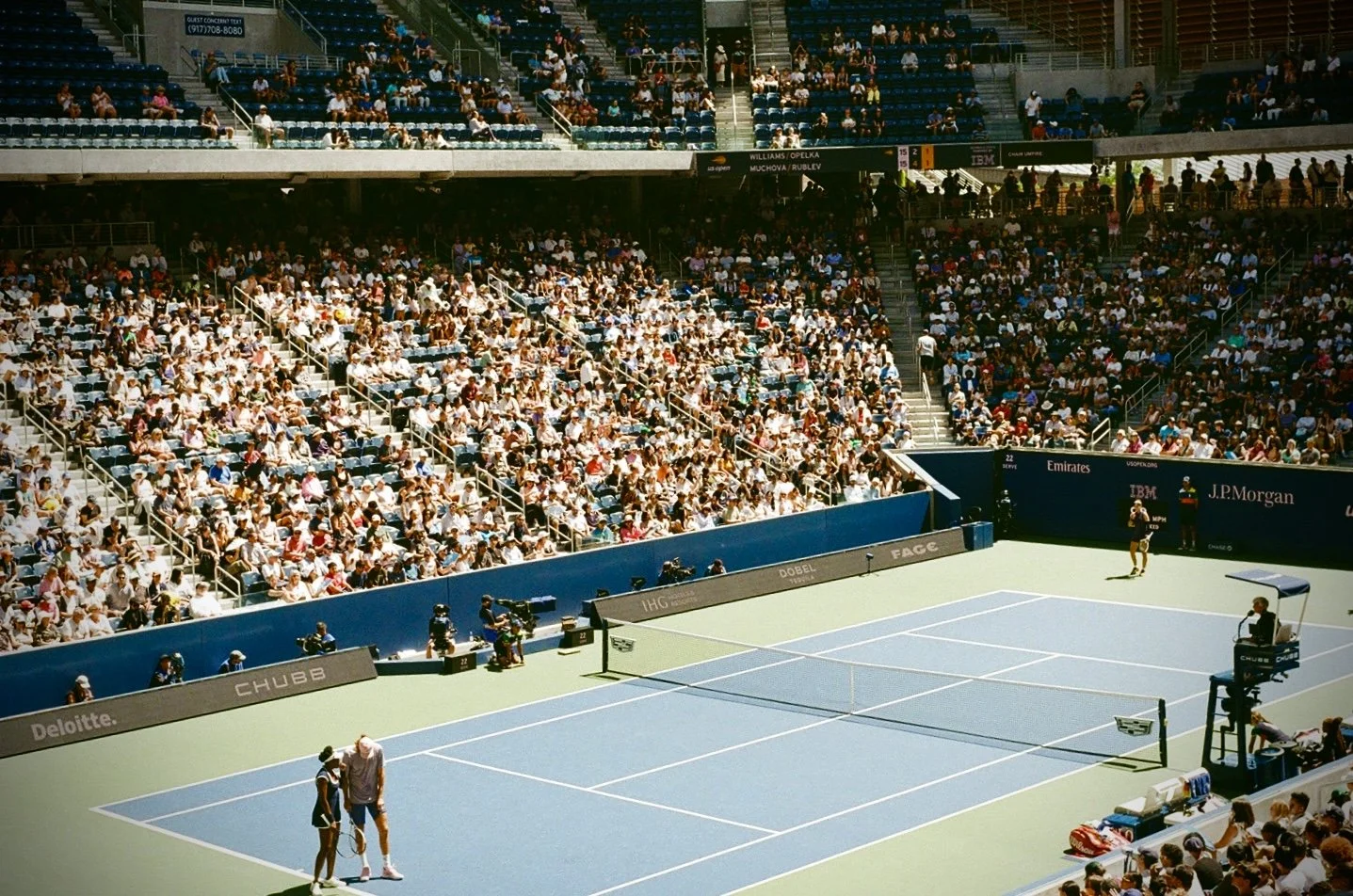
​Over the past month, I sat in a crowd of 20,000-ish people at an Olivia Dean concert at Madison Square Garden. I went to a Chance the Rapper concert in Central Park, packed with people bonding over their love of music. Earlier in the summer, I stood packed in Habana Outpost, watching thousands of New Yorkers watch the playoffs. I watched as thousands of New Yorkers descended upon Lower Manhattan, some getting up as early as 3 am,  to celebrate the Knicks’ win. I sipped cider in crowded bars, celebrating and cheering on my favorite team (that was constantly changing with each loss or upset) in the World Cup.

In each of these moments, I’ve been so curious: if this many people can be mobilized for concerts, for soccer matches, for artists, why can’t they do the same for politics? Especially when the stakes – of winning livable wages, healthcare for all, of getting data centers out of our communities - are so much higher? 

​And this is the question - as an organizer, as an artist - that I feel deeply called to explore. What if artists used their platforms to not just re-post or uplift causes, but build real power by partnering with social movement groups? Inviting their fans to join direct actions, donate, or get involved with movement organizations?  What if artists actually stood up to corporations and used their platform and leverage to get wins for everyday working people? One example is Olivia Dean, who called out Ticketmaster for their wild resale prices; as a result, Ticketmaster capped future resale tickets and gave funds to those who overpaid for resale tickets. It didn’t stop ticket scalpers on other sites, but it was a start. 

As I reflect on my journey organizing over the past 7 years, and look ahead to where I feel my interest is being called, I’m so intrigued about what exists at the intersection of arts & social movements. So much so that I feel a calling to explore what might be possible if more artists used their power, leverage, and resources to uplift movements, organize more young people, and fight back against corporations to achieve wins for their fans.

​I always come back to this quote by Toni Cade Bambara, “The role of the artist is to make the revolution irresistible.” And what would it take to make politics core to the cultural fabric of the United States? And what role can artists play in making that possible? 

“If we want life on this planet to become more just, more free, more equal – if we want all people to live full, safe, dignified lives; if we want an economy and political system that work for the many and not just the few; if we want to undo the core systems of white supremacy, patriarchy, and capitalism that make up empire and shape the values and institutions that govern our lives – we will need movements.

There is no path towards the world we all deserve without massive numbers of people taking serious, steady, long-term action in organizations, in the streets, in their neighborhoods, in their workplaces; contesting for power there, in the economy, and at all levels of government.”

Yotam Moram, For Louder Days

Black Bodies and the Fight for a Green New Deal.

Dreaming of Black Liberation and the Green New Deal

In a society hellbent on destroying Black bodies, for me, the Green New Deal represents one of the most comprehensive visions of society that not only strives to address the single most existential threat to humanity -- climate change-- but also liberate Black bodies in this country. Here’s why I will spend the rest of my life fighting to make the vision of the Green New Deal real for Black people across America. 

My grandmother, LaVerne Dial -- known as Nanny by the family -- was born in 1941, in Atoka, Tennessee. Her parents, sharecroppers, raised eleven children. Their bodies toiled the land; being Black and poor, she shares stories of how at times, when the family didn’t have money because the white landowner milked them of their profits, they’d eat mud to satiate their hunger. 

My parents, Sedrick and Kaeva, met at FedEx. My mother, all 5 feet of her, was known for getting a package where it needed to be on time. My father, a barber, used his hands to cut hair and his mouth to share stories with Black men who were eager for an outlet to talk, to joke, to connect. When he wasn’t cutting hair, my dad spent his time off fishing in lakes across the Midwest. Occasionally, he’d take me along, pink Barbie fishing rod in tow and on these trips, I developed an immense love for nature and the water. Later, his hands would go on to put bags onto planes, in below zero degree weather, for a corporation that did not value or see worth in his body, only saw it as property to be exploited for profit. He currently has four herniated disks to show for it. 

My body, a body so deeply drawn to the magic of the Earth, a special tethering likely a result of our shared trauma; my ancestors and Black bodies today, like the Earth, have been pillaged at the hands of white supremacy and capitalism.  

My body, a body with more freedoms granted than the Black bodies before me. And still, I dream of the day where I can wander the streets at 3 am without fear of violence or assault. Where I can take feet to the pavement of my hometown, without fear of shootings or of gun violence. 

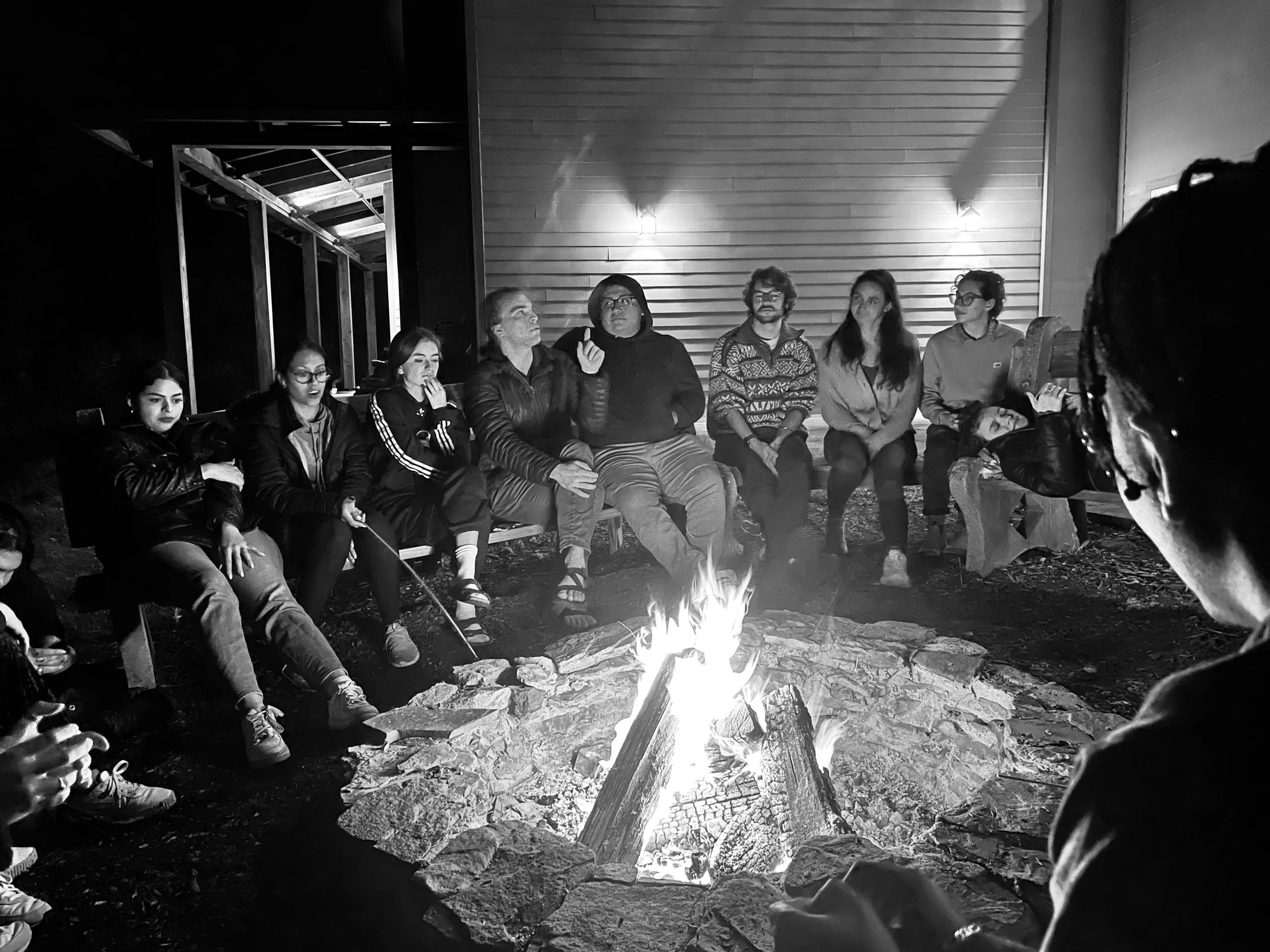
It wasn’t until I joined Sunrise, a youth led movement fighting to stop the climate crisis and win a Green New Deal, that I began to see and truly feel the possibilities of what my body could feel. It was in the trainings I attended with Sunrisers from across the country, in the bonfire circles scheming about how we’d bringing in young people en mass across race and class. It was in getting arrested for the first time in Delaware alongside 20-something other organizers and in the jubilee of singing movement songs, that I felt a deep solidarity with the many young organizers I met who knew that collective action was needed to address not just the climate crisis, but also build towards a world in which all life, all bodies, mattered.

In Sunrise, I learned about the Green New Deal (fun fact, one of the key architects of the GND is Rhianna Gunn-Wright, a Black woman from Southside of Chicago), about the promise of good union jobs and safe neighborhoods for Black people on the South Side of Chicago. I saw a world where Black bodies were not riddled with cancer because of the Chevron’s and Exxon Mobile’s of the world who see Black bodies as collateral damage for their oil and gas profits. A world where my own children's bodies could breathe in fresh air without fear of asthma. Where they could laugh, play and rest, without fear of crisis after crisis after disaster. Where they aren’t threatened by the trigger of a white police officer’s uncontrollable temper. Where their bodies can work dignified jobs and have a hand in the collective project of transitioning our country away from fossil fuels, away from capitalism, and towards a future where people and the planet thrive over profit and corporations.

In the spirit of Ella Baker, Martin Luther King Jr., and the Black Panther Party, Black bodies who fought for the liberation of Black people, I fight for a Green New Deal for the millions of Black bodies that are and that are to come. To experience love, to experience joy, to experience life, to experience true freedom. Because every body deserves that.  

So I invite you to sit with more for a moment and ground in your body. Really feel what might be possible in your body, if we lived in a world where the Green New Deal was our reality? In a world where your body might release, exhale, and soften in this world, instead of restrict and tighten? And I invite you to ask yourself: What are you willing and ready to do to bring that future about?

And if you want to make the Green New Deal real, join Sunrise or support our movement here :)

Half-baked thoughts on where the Movement for a Green New Deal should go next.

On the Green New Deal.

I have committed the rest of my life to the project of stopping climate change and winning a version of the Green New Deal I saw in the AOC Video. Though deeply passionate and hungry for a world where a GND is made real, at present, I feel a deep lack of direction and strategy around what happens next for the movement for a Green New Deal.

In the gap, I wanted to make some meaning for myself, on what are the challenges in the way of winning a Green New Deal, and how might we overcome them to win? 

I’ll preface this by saying that, given the sub-header, these are half-baked thoughts. I don’t have the time to spend weeks researching, editing, and fact-checking all of these assessments and ideas. I’m not a journalist, I’m no policy wonk. I’m just an organizer trying to think, day in and day out, of how to create the people power & political conditions to win massive revolutionary policy at the federal level on climate. (Which, when I say climate, to me, also means massive investments in the public sector, in housing, in transportation, in education, in energy.) If you pull back the curtain on how I define climate, what I mean is fighting for a world where people and the planet thrive, not corporations and profit. A visionary climate future is also a future of economic and racial justice. 

So. This piece will include a simple assessment of some of the major barriers in the way of a Green New Deal, and then share some ideas, based on that assessment, on where the movement for a Green New Deal could go next. 

Assessment & Diagnosis

So what’s wrong? What’s standing in the way of the Green New Deal? 

  • The Green New Deal as a floating signifier: First, the Green New Deal has become a floating signifier of sorts, both for the left, for the far right, and for centrist Democrats like Biden. 

    • I don’t think this means we shift towards something different; I just think we need to get a little bit more specific; what are we trying to win by 2030? The Inflation Reduction Act (IRA), was not, by any means, the Green New Deal. So what massive federal GND policy/legislation is? How will we know when we have won? What policy are the milestones to indicate success along the way? 

  • Lack of adequate plan to weaken the power of the Fossil Fuel Industry: It is clear that the fossil fuel industry still holds an immense amount of power over our government. From the imprints of industry on IRA to the role they played on the global stage at COP, we have to reckon with the fact that, if we are to pass a Green New Deal, the power, the money, the lobbying of the fossil fuel industry, must be diminished.

  • Inability to build a Multi-Racial, Cross-Class, Cross-Geography Mass Movement: We need a mass movement ready to protest, disrupt, take action, and turn out at the polls to win a GND… in strategic places, and everywhere. We must figure out how to organize the unorganized. Or organize people, where they are organized (e.g., artists, sports teams, video gaming) towards political action and mass disruption around the Green New Deal. And at least get more people doing something (whether it be giving money, giving time, speaking out, joining protests, etc.) on climate. 

  • Weakening Democracy and government that is unable to pass policy & solve society's core problems: We don’t live in a democracy, we live in an oligarchy; the rules of the system in the U.S., have been built around white supremacy and around the wealthy/elite/ruling class. With that, our government doesn’t govern to solve problems. And I don't need to underscore the severity of the stakes. The total collapse of society as we know it sits on the other side if bold and big action on climate isn't taken. 

    • Other things. Public opinion on the side of climate, yet nothing changes; don’t have a government apparatus accountable to the people and public. Must shift. How? 

    • While organizations and movements fight to pressure, someone, somewhere, must also be pressuring to change the roles of the game. Abolish the Senate, the filibuster, and the Electoral College. Pack the court with liberal justices, so we can do things like overturn Citizens United, which gives unprecedented levels of power to corporations to lobby our government. End gerrymandering. 

    • Move to offense; we have fossil fuel corporations passing policies in states across the country, preventing civil disobedience and classifying activists as terrorists. We must be pushing policy to define fossil fuel as terrorist; and play with the rules to our benefit and advantage, as they do. 

  • We don’t have mass media telling the story & vision of a Green New Deal future: There is a vision and alternative to the nightmare and hellish reality we live in. We need to harness the power of art, media, and culture to inject the vision of a Green New Deal future into the hearts and minds of the public. People need to feel and want the Green New Deal so badly that they’d be willing to get it, by any means necessary. AOC video is one example; we need more artists jumping in to paint the vision Green New Deal future for the masses.

The one final thing I want to note, though I haven’t included, is the role of the military and war. Given two massive wars, one happening in Ukraine and one happening in Gaza, and oil sitting in the backdrop of both (geopolitical), have more questions than answers around the intersection of the Green New Deal and war/imperialism. 

So with that assessment. Here are 5 things I think the Movement for Green New Deal should be oriented around: 

  • Clear GND policies that both push towards decarbonization, help to deliver a death blow to the fossil fuel industry, and deliver massive wins for the public: Clear visionary policy that is popular, weakens the power of the fossil fuel industry and delivers wins to the public. One example of this could be a Green New Deal Universal Basic Income Program, a policy that creates a carbon tax (tied with emission reductions that need to happen), and all funds raised are delivered in universal basic income checks to everyone in the country.  

  • The vision of the Green New Deal, everywhere, all at once: Imagine, a leftist Green New Deal comms shop with its own news Podcast, a suite of artists, its own set of writers and filmmakers, TikTokers, Instagrammers, flooding the masses and public with a powerful vision of the Green New Deal. 

  • Fossil fuel offender list: Pledge calling on institutions to refuse to do business with the fossil fuel industry, especially tech (given the role, relationship, and power Big Tech could have over Big Oil) and advertising. Also, push for legislation creating an offender list for fossil fuel leadership. They are committing crimes against humanity and should be treated as such.

  • Seed a Democratic Organization within the movement ecosystem: We need someone working on changing the rules of society so that it's easier to win on our demands. This could include both pushing for legislation that does things like Abolish the Senate, creating publicly funded elections so working and poor people can afford to run fo office, end gerrymandering, end the filibuster, etc. This means pushing for automatic voter registration for all people. And hell, why not mandate online voting to decrease the barriers around voting. Folks in the military who are overseas and folks with disabilities already vote online. 

    • Also, this means pushing for policies that enable people & the public to have more time to organize and participate in civic life. Imagine universal healthcare, universal childcare, universal paid time off (e.g., everyone is guaranteed a 1 - 2 month vacation in this country, time for leisure and play), etc.

  • Experimentation around mass organizing of unorganized: The movement for a GND, right now, is a very tiny sliver of the population. For us to win the full vision of a Green New Deal, we need more political power and more people. We have to get sharper at organizing people where they are, whether it’s gamers on Twitch, fans at concerts (+ organizing celebrities to use their platforms to guide young people into our movements), sports leagues, etc. We are not growing our bases; to push the government to act on climate with the scale and urgency with which it demands is going to require massive organizing of hundreds of thousands of people in this country. 

So. I’m excited about winning a Green New Deal in this country; I want it badly, for myself, for my nephews, and for my future children. To live in a world beyond the climate apocalypse we are headed towards. My hopes in writing this are to open a convo with my peers on what’s in the way of winning a Green New Deal, and what it’s going to take to make it happen.

*P.S. Yet another disclaimer. These are half baked thoughts. Some of them are imperfect, some of these are out there ideas, and you may have plenty of counter arguments! Engage with me, and write thoughts and responses in the comments :)